

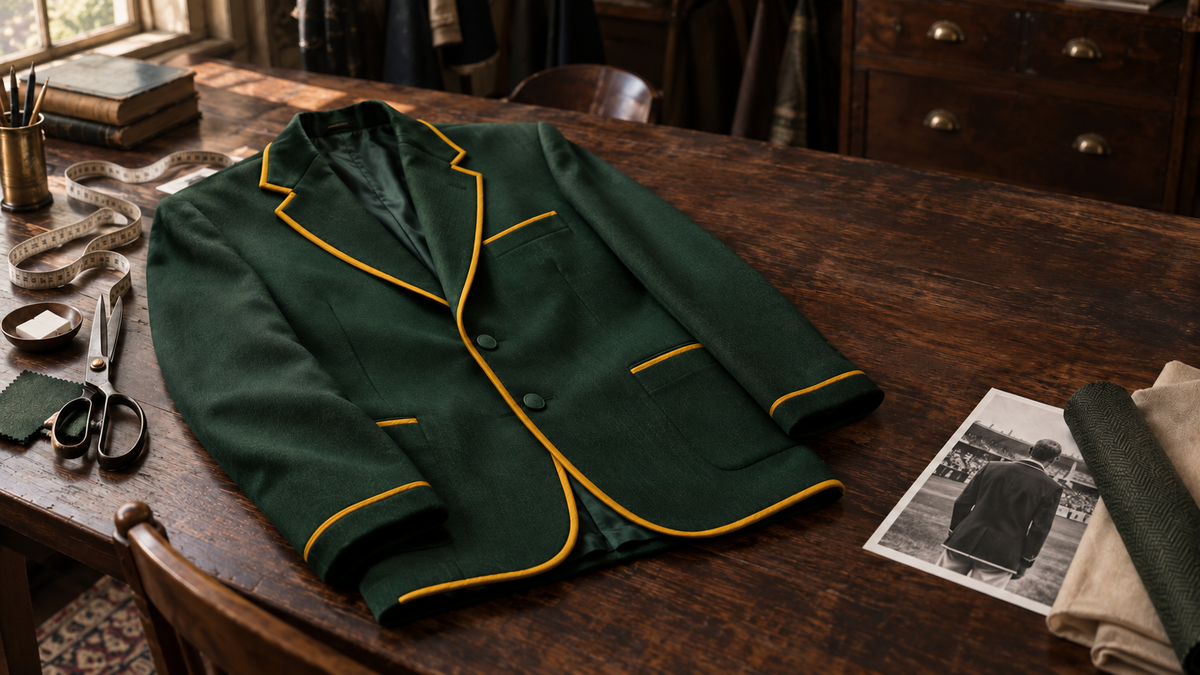
Some uniform projects are commercial assignments. Others become a small part of Australian sporting history.
When Cricket Australia approached me to help create new Test cricket blazers for Australian captain Ricky Ponting and vice-captain Adam Gilchrist, the brief carried a level of meaning that went well beyond the garment itself. The Australian Test blazer represents tradition, achievement and the responsibility of representing the country at the highest level of the game.
Ricky also had a clear vision for what the new blazer needed to represent. It was to honour his Tasmanian roots, respect the heritage of Australian Test cricket and draw its design inspiration solely from the style of blazer worn by Sir Donald Bradman.
A Test Blazer Grounded in Australian Cricket Tradition
The project began with two requirements from Ricky Ponting that shaped every subsequent decision.
First, as a proud Tasmanian, Ricky wanted the blazer made from pure Tasmanian wool. This was more than a fabric selection. It created a direct connection between the captain, his home state and one of Australia’s most recognised natural fibres.
Second, he wanted the design based on the same style of jacket worn by Sir Donald Bradman. The intention was not to create a fashionable reinterpretation or modernise the garment beyond recognition. It was to study the proportions, formality and visual language of a historic Australian Test blazer, then translate that heritage into a bespoke garment suitable for the modern Australian captain and vice-captain.

The Honour of Colour-Matching the Baggy Green
One of the most memorable moments in the process came when we were entrusted with an Australian Test cricket Baggy Green cap so the blazer colour could be matched accurately.
For most cricket supporters, the Baggy Green is something viewed from the grandstand, on television or behind glass. Very few people will ever have the opportunity to hold one, let alone use it as the physical reference for a garment being created for two of Australia’s leading Test cricketers.
That trust made the responsibility very real. Colour decisions made from photographs or screens can be unreliable because lighting, camera settings and display calibration alter how a shade appears. Having the genuine cap available allowed the colour comparison to be made against the real object. In a project so closely tied to Australian cricket identity, “close enough” was never going to be an acceptable standard.
Turning Sporting Heritage into Two Bespoke Garments
With the historical design direction, the pure Tasmanian wool requirement, the Baggy Green colour reference and the measurements of Ricky Ponting and Adam Gilchrist, we could begin the work of translating the brief into finished blazers.
A bespoke blazer must do more than match a set of measurements. The balance of the garment, the relationship between the shoulders and chest, the sleeve length, the way the front sits when buttoned and the overall proportion all affect how it presents. When two garments share the same heritage design but are made for different bodies, each pattern must be resolved for the individual wearer.
The challenge was to preserve the dignity and recognisable tradition of the historic reference while producing blazers that belonged to Ponting and Gilchrist—not costume replicas. Every decision needed to serve the same idea: a formal Australian Test blazer with a clear line back to Bradman’s era, made for the leaders of the contemporary team.

A Blazer Connected to Australia’s Historic 2004 Series in India
The completed blazers became associated with one of the defining achievements of that Australian team: the 2004 Test series victory in India.
Australia won the four-Test series 2–1, its first Test series victory on Indian soil since 1969–70. Ponting was the official captain but missed the first three Tests while recovering from a broken thumb. Gilchrist stepped into the captaincy for those matches, and Ponting returned for the fourth Test in Mumbai.
That detail makes the story of the two blazers especially fitting. They were created for Australia’s captain and vice-captain, and both men carried leadership responsibilities during a tour that ended a 35-year wait for a series win in India. Cricket Australia has since described the 2004 result as Australia’s first success there in 35 years, while Gilchrist has reflected on it as one of the team’s finest achievements.
For me, seeing garments we had worked on become part of the visual history surrounding such an important period in Australian cricket was an extraordinary professional moment.
Why Heritage Uniforms Require More Than Decoration
This project reinforced a lesson that has remained central throughout my career: the most meaningful uniforms are not simply garments with an emblem added to them.
A heritage uniform can carry the identity of an organisation, the history of the people who wore it before and the expectations placed on the person wearing it now. Material choice, colour, fit, construction and historical references must work together. If one element is treated casually, the finished garment can lose the very meaning it was meant to represent.
The same principle applies outside elite sport. A company blazer, team jacket, commemorative garment or long-running uniform program should begin with the organisation’s real requirements. Who will wear it? What does it need to communicate? Which details are historically or culturally important? How will it be fitted, reordered and maintained? Those questions lead to a better result than beginning with decoration alone.
A Proud Chapter in the Uniforms.com.au Story
Creating custom Test cricket blazers for Ricky Ponting and Adam Gilchrist remains one of the proudest projects of my career. It brought together Australian wool, Tasmanian identity, the legacy of Sir Donald Bradman, the symbolism of the Baggy Green and the leadership of two remarkable Australian cricketers.
Most importantly, it demonstrated what considered uniform design can achieve. The right garment can respect the past, serve the present and become connected to moments people remember for decades.
If your organisation is planning a custom uniform, presentation blazer or heritage apparel project, speak with the Uniforms.com.au team about the history, function and practical requirements that need to be built into the brief from the beginning.
Historical Note and Sources
The garment-development details in this article are based on Jason Ham’s firsthand recollection of the project. The result and leadership context of the 2004 India series were checked against Cricket Australia’s retrospective, “Our finest achievement”: Aussies reflect on India 2004 success, and the contemporary series record.
About the Author
Jason Ham is the founder of Uniforms.com.au and a respected Australian authority on uniforms and workwear. With more than 27 years of industry experience, Jason brings extensive knowledge, practical insight and a deep understanding of the apparel needs of Australian businesses.
His expertise and entrepreneurial experience were also showcased in the book Entrepreneurs Exposed, recognising his contribution to the industry and his journey as a successful Australian business founder.
Share:
How Uniforms.com.au Saved Symbion Health the Cost of Two Full-Time Accountants
How We Delivered Urgent Team Uniforms for NAPA Auto Parts Racing at the Bathurst 1000